SK Hynix ADRs Priced At 3% Premium As Wall Street Readies Wave Of Leveraged ETFs
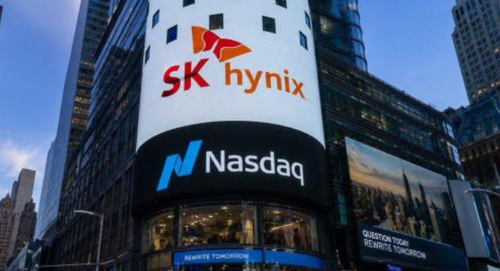
The next test of the AI trade arrives today, as South Korean memory-chip maker SK Hynix’s American depositary receipts begin trading under the temporary ticker SKHYV.
Shares were priced at about a 3% premium to Thursday’s close of its ordinary shares in South Korea. The $26.5 billion offering attracted demand for roughly seven times the shares available, forcing the chipmaker to scale back allocations to major investors, according to Bloomberg.
The company sold 177.9 million ADRs at $149 each, raising $26.5 billion, surpassing Alibaba’s US debut to become the third-largest listing in history. Each ADR represents one-tenth of a Seoul-listed common share, giving US investors direct exposure to the world’s leading supplier of high-bandwidth memory amid the AI boom that could soon unlock the Physical AI boom.
According to the report, Baillie Gifford, Coatue Management, and Situational Awareness Partners received about $5 billion of ADRs, roughly $2 billion less than indicated. Over 500 institutional investors placed orders, including long-only funds, technology specialists, and sovereign wealth funds. The allocation remained concentrated, with 10 investors taking half the deal and the top 25 accounting for about two-thirds.
Wall Street analysts weighed in with their first takes of the deal, courtesy of Bloomberg:
Jung In Yun, CEO at Fibonacci Asset Management
- “I take 3% premium as a constructive signal. It shows that global investors are still willing to pay up for direct US access despite the recent volatility in Korean equities”
- From the company’s and banks’ perspective, the level looks sensible; it is strong enough to demonstrate demand, but not so aggressive that it creates unnecessary aftermarket risk
- In the current market, a clean, stable debut matters more than squeezing out the last few percentage points of valuation
Sanghyun Park, founder of Clepsydra Capital
- It shows global funds accept paying up to bypass local index and currency friction and direct exposure to the company’s HBM dominance
- The banks capitalized on the limit to conversion that prevents arb traders from instantly erasing the spread on the first trading day
- This avoids the typical Korea Discount seen with legacy local names and points toward a TSMC-style scarcity model
- “Since 3% is just the primary floor and the float is so heavily choked, we could easily see the premium gap much higher once US trading opens on Friday”
Travis Lundy, an independent special situations analyst who publishes on Smartkarma
- “To me that is not that much of a premium. Eminently reasonable given the current swap rates on owning SK Hynix” local shares
- The 3% premium to Thursday’s close is actually a discounted price to Wednesday’s close and every other close for the past few weeks when investor demand was “multiple times” the offering size
- There is an interesting dynamic whereby if the headroom expands, it will take pressure off the banks to fund local into swaps, which should reduce the swap rate, which should in turn reduce the ADR premium slightly
Dilin Wu, a strategist at Pepperstone Group
- “The 3% premium tells you the roadshow demand was strong enough to price above Thursday’s Korean close — and that’s the first concrete evidence that the accessibility premium is real”
- The real test will be the first two weeks of trading before upcoming earnings; if the ADR consistently trades above the Korean share dollar equivalent, it confirms US investors are willing to pay a premium for accessibility — and that should pull the Korean shares higher
- The ADRs could be included in the Nasdaq 100 in December; once that inclusion happens, passive fund inflows from vehicles like the Invesco QQQ become a mechanical buying force
Francis Oh, head of Asia business development at Rex Financial, which provides exchange-traded products
- “The current 3% premium should not be over-interpreted at this early stage”
- “TSMC’s 18% premium reflects structural friction that accumulated over years, not a level established immediately post-listing; any meaningful convergence or divergence for SKHY toward comparable levels is more likely to unfold as a gradual”
SK Hynix’s ADR offering comes weeks after SpaceX tapped the public markets in the largest initial public offering in history, while Alphabet is raising $85 billion to fund its AI buildout. Traders are betting heavily that AI-related demand is a secular growth story for memory stocks, which have historically been viewed as more cyclical.
Bloomberg expects that the US debut of SK Hynix will unlock a new “wave of leverage ETFs” tied to the chipmaker’s American depositary receipts. It expects ProShares, Leverage Shares and Rex Shares are some of the fism planning to products taht offer 2x daily returns on the memory chip giant.
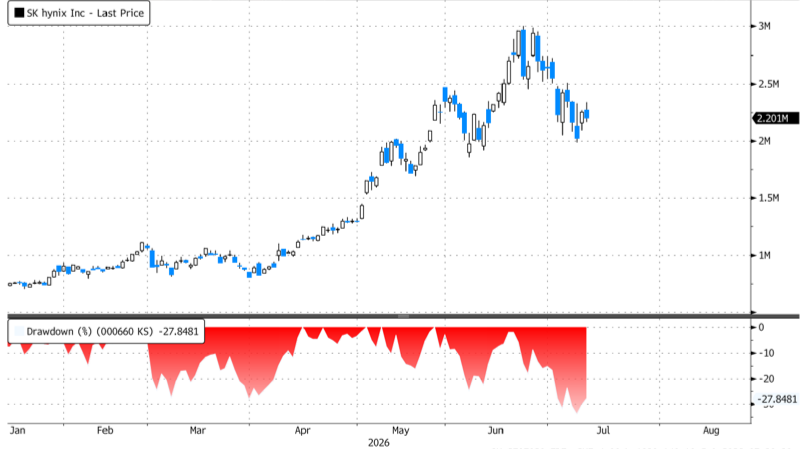
Bloomberg Intelligence noted:
A fresh pool of leveraged US-listed ETPs would mean the daily rebalancing flows would grow larger, potentially fueling already heightened volatility. The size of the leveraged products also made it difficult to meet the promise of delivering twice daily returns, creating a tracking gap.
The key question is whether SK Hynix’s blockbuster ADR offering can juice memory stocks again, especially after our note earlier this week, “South Korea Falls Into Bear Market As Memory Euphoria Fizzles.”
Tyler Durden
Fri, 07/10/2026 – 08:25