
NOAA Winter Outlook: Record El Niño Points To Wetter South, Warmer North
El Niño is a warm patch of water in the equatorial Pacific that shows up every few years and confuses everyone as to what it’s actually going to do. When the eastern Pacific runs hot, the jet stream drops south and drags the storm track with it. That is why a water temperature reading off South America decides whether California floods and the Gulf gets hammered.
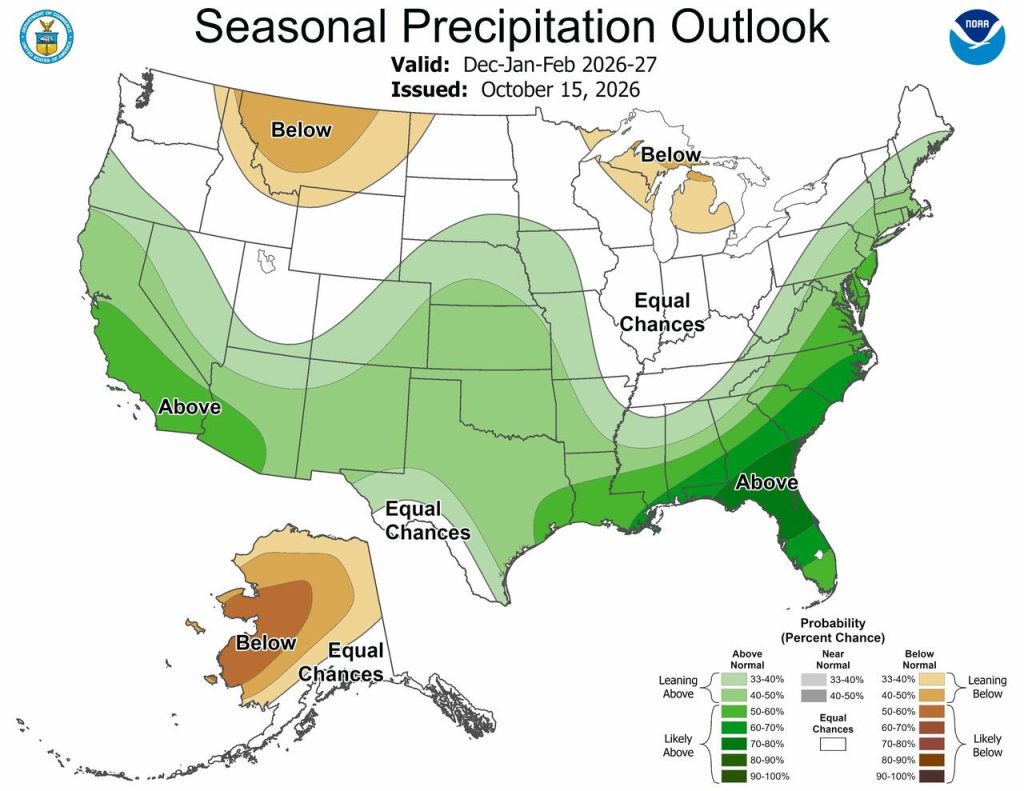
NOAA’s winter outlook, released this morning, favors a wetter than average December through February across the southern U.S., from California to Florida, and along the Eastern Seaboard, with warmer than average temperatures across the North.
It expects drought to improve or end in the Southwest, the southern Great Plains, the Southeast and parts of the East Coast, and to develop or worsen in parts of the northern Rockies, northeastern Oregon and eastern Washington. “As we know from decades of observations, a very strong El Nino will likely bring a southward and eastward shift to the jet stream for the contiguous U.S., which tilts the odds toward stormier weather across the South,” said National Weather Service director Ken Graham, who warned that “too much precipitation on dry soil can fuel destructive flash floods and mudslides.” Like every NOAA seasonal outlook, it gives the odds of a wetter or drier, warmer or colder season, and it doesn’t project snowfall.
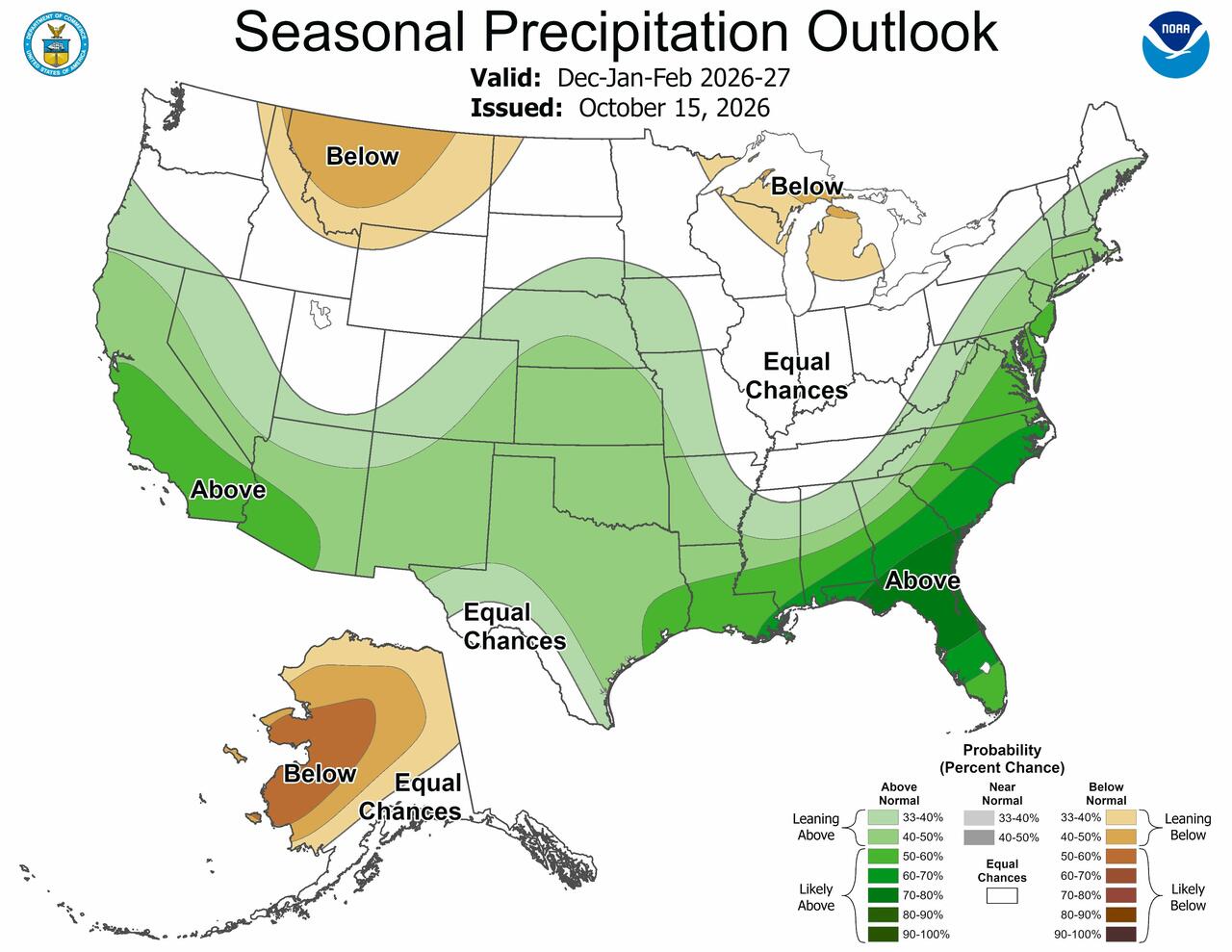
The Climate Prediction Center’s three-month outlook for January through March, also issued today, carries the same pattern into spring: wetter than average from California and the Southwest across the Gulf Coast and up the East Coast, with the strongest odds in Southern California and along the Florida and Georgia coast, and warmer than average across the northern tier from the Pacific Northwest to New England. The Southeast stays near normal on temperature, and parts of Montana and Michigan lean dry.
This year’s reading is off the charts. NOAA’s Climate Prediction Center said Oct 8 that El Niño is still strengthening, with better than 83% odds of a strong to very strong event through early next year, and an 83% chance that it tops every El Niño on record back to 1950 over October to December. On Sept 21 the daily surface temperature where El Niño forms ran more than 3°C above normal, a daily record, months before the expected peak.
What A Strong El Niño Does To An American Winter
For this winter, NOAA favors warmer than average temperatures for northern California, the Pacific Northwest, the Midwest, the Mississippi Valley and much of the East, near normal temperatures for parts of the Southeast including Florida, and drier than average conditions for parts of the northern Mountain West. That fits its review of a century of events, which found the most reliable signal is a wet Gulf Coast: wetter than average from Texas to Florida in more than 80% of El Niño winters. California is the swing state; in the two strongest events on record, 1982-83 and 1997-98, it got much more rain than usual. The Ohio Valley trends dry, and the Pacific Northwest and northern Rockies often run mild. In NOAA’s words, “the stronger the episode, the more reliable the signal.”
NOAA’s post-mortem of the 1997-98 winter counts four weeks of nearly continuous storms in California, 35 counties declared federal disaster areas and more than $550 million in damage. Santa Barbara took 21.74 inches of rain in February alone. In Florida, a two-day tornado outbreak killed 42 people. Nationwide the winter claimed 56 lives, and a Northeast ice storm left power lines down for weeks.
Forecasters are already split on where this one hits hardest. Meteorologist Ryan Hall is watching a corridor from Oklahoma and Arkansas through Tennessee, Kentucky, Virginia and the Carolinas: “somebody in this corridor is going to get a big snowstorm or a big ice storm this winter.” AccuWeather’s Paul Pastelok expects floods to matter more: “It may be more about rainfall this year.”
The National Weather Service is changing its own warnings for this winter. Starting this season, select blizzard and ice storm warnings will carry “Particularly Dangerous Situation” wording, reserved for high-confidence storms of historic severity that pose “imminent danger to life and unprecedented disruptions to emergency services.” NOAA updates the outlook again on Nov 19.
The Fall Was The Warm-Up
El Niño’s wind shear held the Atlantic’s first hurricane back about four weeks past the previous modern record. When one finally formed, it still did real damage. Hurricane Isaias came ashore near Destin, Florida, on the evening of Oct 9 with 105 mph winds and knocked out power to about 830,000 homes and businesses across Florida, Alabama and Georgia. Before landfall, producers shut in 63% of Gulf crude output and 57% of its natural gas, and WTI rose as much as 5.6% in a day.
California didn’t wait for the first storm. Gov. Gavin Newsom declared a statewide emergency on Sept 21, readying the National Guard for floods and staging sandbags, pumps and road-closure equipment.
The grid is running tight going into winter. PJM Interconnection, which serves 67 million people from the Mid-Atlantic to Chicago, declared a low-level emergency this week when an October heat spike hit with 60 gigawatts of generation down for maintenance, and spot power at its western hub touched $1,021 a megawatt-hour. A PJM spokesman said “unpredictable weather patterns are providing fewer days to perform important maintenance.”
The food bill comes later. JPMorgan analysts expect El Niño’s biggest hit to farm output in the first quarter of 2027, on top of diesel and fertilizer shortages, and the UN Food and Agriculture Organization’s chief economist told CNN global food prices were already climbing before El Niño arrived.
Recall, the numbers:
- NOAA’s winter outlook, out Oct 15, favors a wetter South and East Coast and a warmer North, and the January to March outlook keeps the same tilt.
- NOAA gives 83% odds this El Niño tops every one on record for October through December.
- The Gulf Coast runs wet in more than 80% of El Niño winters.
- Isaias, the Atlantic’s first and very late hurricane, still cut power to about 830,000 customers.
- The 1997-98 event put 35 California counties under federal disaster declarations.
Now for the disclosure…
We sell emergency gear, so this part is an ad. But whether you buy from us or not, floods, ice storms and long outages tend to end the same way: roads closed, shelves thin, power out and help slow. You should have two weeks of food, water, light and power that don’t depend on the grid.
Through Nov 15, any order with $149 or more in survival gear or emergency food gets a ZeroHedge waxed canvas hat free. Its waxed coating is water resistant. Support yourself & support the site, build your kit here. And if you don’t buy ours, build one anyway.
Practical Takeaways: Two Weeks, Four Boxes
FEMA’s baseline is a gallon of water per person per day for several days, food that doesn’t need a fridge, a flashlight, a first aid kit and a phone charger with a backup battery. Two weeks is where most people who have sat through a long outage end up.
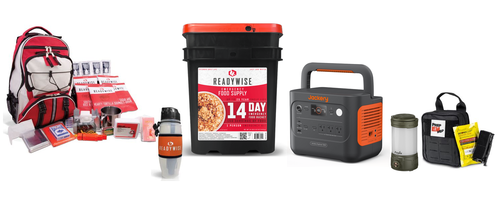
- Food and water: the ReadyWise 14 Day Emergency Food Bucket ($149.99, and the hat comes with it) holds 25,580 calories, about 14 days for one person at 1,800 a day, with a shelf life of up to 25 years. Just add water. The Seychelle filter bottle ($34.99) is rated for up to 100 gallons of fresh water. Seychelle says it isn’t designed for salt, stagnant or murky water, so store jugs too.
- Light: the Fenix CL26R PRO lantern (from $67.95) puts out 650 lumens, runs up to 408 hours, and doubles as a power bank for a phone.
- Power: the Jackery Explorer 1000 v2 ($559) stores 1,070 watt-hours and puts out 1,500 watts, enough to keep a fridge, a CPAP or a router going for hours, and it runs silent indoors where a gas generator can’t.
- The go bag and the med kit: flood country means evacuations. The 64-Piece Survival Backpack ($94.99) is packed with three days of food, a stove and a first aid kit; it is short on water, so pair it with the filter. The PrepEM Wild Essentials Pro ($129.95), designed by board-certified emergency medicine physicians, adds a tourniquet and hemostatic gauze.
El Niño won’t hit every house, and NOAA says so. But the odds this year are the highest on record, and California, the Gulf Coast and the grid are already bracing for it.
Through Nov 15, $149 or more in survival gear or emergency food gets the waxed canvas hat free, and orders over $75 ship free in the US. Build your kit here. Or build it from whatever you already have. The point is to have it.
Tyler Durden
Thu, 10/15/2026 – 17:00