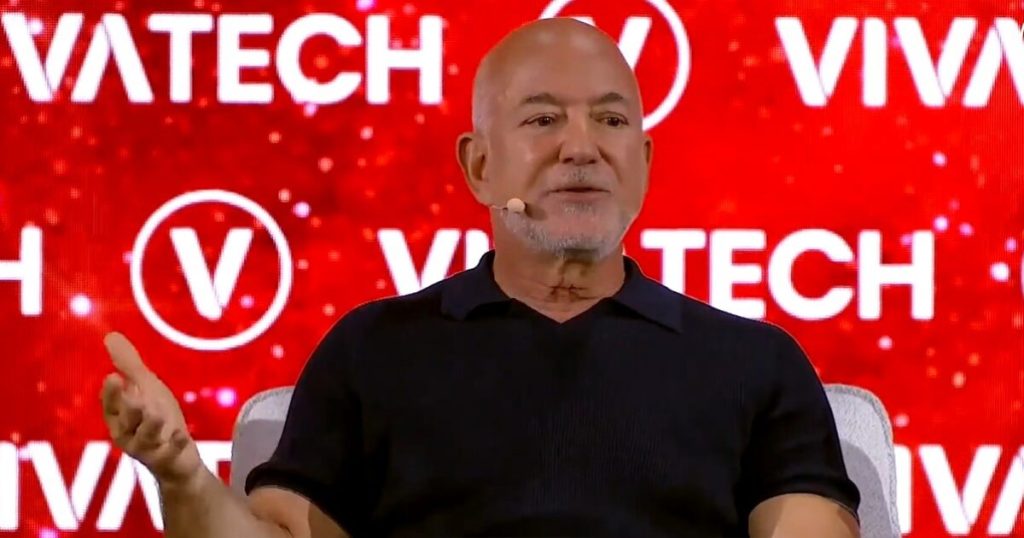

Months before he downsized the Washington Post, Amazon founder Jeff Bezos privately told President Donald Trump at a December 2024 dinner that buying the Post had been his worst investment decision ever.
Why? Because the Post’s elitist, uppity, bougie, holier-than-thou staff were too full of themselves to listen to the successful boss man.
“The people there are terrible. They don’t listen. My other companies, they listen,” he told the president, according to a new book by Jonathan Swan and Maggie Haberman of the equally foul New York Times.
An excerpt of the book, “Regime Change: Inside the Imperial Presidency of Donald Trump,” was shared with the New York Post.
Jeff Bezos told Trump the Washington Post was his ‘worst investment’ and that ‘the people there are terrible’ during a December 2024 dinner, according to a new book by Maggie Haberman and Jonathan Swan. Months later, the Post laid off one-third of its staff and eliminated entire… pic.twitter.com/aB5hkoXvCf
— Fox News Flash (@FoxNews_Flash) June 18, 2026
Bezos’ remarks were made after the Washington Post, a rabidly left-wing paper, posted losses of over $100 million for 2024.
Months later, Bezos laid off one-third of the Post’s staff and eliminated entire sections of the paper. He also directed the Post’s editorial board to focus on “personal liberties and free markets” going forward.
Trump responded to Bezos by correctly noting that the Washington Post “is really unfair” in its coverage.
“You’ve got to take better care,” he added, according to the book from Swan and Haberman.
“Bezos commiserated with Trump over their December dinner, indicating that he, too, was deeply frustrated with the Post, though for a different reason,” the book reads. “In Trump’s telling, Bezos told him he had lost half his friends over the investment. Bezos would tell others that wasn’t quite right: He hadn’t lost friends, but people close to him had urged him to sell the newspaper.”
While speaking with Swan and Haberman for the book, Trump reportedly admitted that he originally “hated” Bezos because he thought the Post’s editorial garbage was being directed by him.
“He said they write stories about him. And I didn’t believe him the first time, first term. And I hated him for it,” Trump recalled. “And then I believed him.”
These days, it’s the radicalized left that despises Bezos, as well as other successful men like President Trump, Elon Musk, etc.
Swan and Haberman’s book also talks about the fallout from former Attorney General Pam Bondi’s disastrous Epstein bungle.
“The secure Situation Room complex, where President Obama and his team monitored the raid that killed Osama bin Laden, became the setting for a string of meetings in which the Trump administration’s most senior officials gathered — without the president — to manage the fallout from public fury over their failure to release the Epstein files,” the book reads, according to Poynter.
Why was Trump himself not at the meeting? Because he was infuriated by the very topic.
“Trump made clear to his aides that he had no interest in releasing anything related to Epstein,” the book notes. “He snapped at anyone who raised the issue, and his staff mostly learned to avoid the subject in front of him.”
Democrats have rushed to exploit this reporting for their political advantage:
The Trump Administration used the White House Situation Room to plot the cover up of the Epstein Files. And it all happened at the same time Mike Johnson shut down Congress to avoid the issue—not a coincidence.
This is the biggest cover up in American history. pic.twitter.com/6kxScWoskr
— Congresswoman Yassamin Ansari (@RepYassAnsari) June 17, 2026
The book also alleges that President Trump attempted to get a Wall Street Journal story about his relationship with deceased pedophile Jeffrey Epstein deleted, going so far as to call the paper’s owner and editor-in-chief.
Vice President JD Vance took a different approach to the Epstein scandal.
“Vance pressed repeatedly for the administration to release everything — even unsubstantiated material about Trump — arguing that Congress would force the issue eventually and that getting ahead of it would earn the White House credit for transparency,” according to the book.